
June 8, 2026 | Hüseyin Büyüközer
Zafer GEDİKLİ (GIMDES TECHNICAL SCIENCE BOARD)
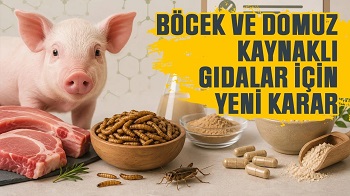
As you may know, the GIMDES fiqh council had previously conducted a study on whether proteins and similar products derived from insects are permissible from an Islamic standpoint. The conclusion — that consuming such substances is not permissible (not halal) for Muslims — was announced on March 25, 2025, via the article published at https://www.gidaraporu.com/bocekprotein_g.htm.
The Ministry of Agriculture and Forestry has also been following the matter, and on May 20, 2026, the Ministry closed the door on this issue through the Turkish Food Codex “Novel Foods Regulation.”
In the intervening period, we continuously worked to keep this matter on the international agenda, making clear at every opportunity that various fatwas issued by scholars affiliated with certain Asian states — such as Singapore — on this topic were not appropriate. The purpose was to prevent substances contrary to Islam from being imposed on Muslims based on weak rulings, misinterpretations, and assessments that disregard the welfare of the Ummah, and to strive to protect future generations. GIMDES fulfilled its duty by taking precautionary action and issuing warnings in advance.
Despite this, unfortunately, even within our own country, some “theology scholars” (the term Islamic scholars has been deliberately avoided here) issued unacceptable fatwas — resulting from flawed assessments — stating that insects may be consumed.
Below, I present a summary of the relevant provisions of the regulation on this matter.
“The Turkish Food Codex Novel Foods Regulation, published in the Official Gazette dated May 20, 2026, clearly sets out Turkey’s national food policy in opposition to certain practices approved under European Union (EU) legislation that have been discussed globally in recent years as alternative protein sources in the food sector.
Upon reviewing the text of the regulation, the status of products classified as ‘novel foods’ derived from insects and pigs can be broadly evaluated as follows:
1. A Clear and Definitive Prohibition Policy
Article 7, paragraph 2 of the Regulation contains the following provision, leaving no loopholes whatsoever:
“An application/notification concerning a novel food derived from pigs or insects shall not be accepted, and such foods shall not appear on the novel foods list.”
This provision guarantees that food business operators, entrepreneurs, or importers cannot even submit an application to the Ministry to introduce any insect- or pig-derived alternative to the Turkish market under the status of “novel food.” It is significant that insects are cited alongside pigs — an animal that is unequivocally known to be haram. Just as no exception is made for pigs, the same prohibition applies to substances derived from insects.
2. Divergence from European Union (EU) Legislation
Article 29 of the Regulation states that this arrangement was prepared in alignment with EU legislation, specifically Regulation (EU) 2015/2283 of the European Parliament and of the Council. However, Turkey has exercised its right to protect national sensitivities and consumer rights within this harmonization process:
- Situation in the EU: The European Food Safety Authority (EFSA) has in recent years approved certain insect species — such as yellow mealworm (Tenebrio molitor), migratory locust (Locusta migratoria), and house cricket (Acheta domesticus) — for use at specified levels as “novel foods” in food products (flour, biscuits, pasta, etc.).
- Turkey’s Position: Turkey has added a special exemption to the regulation in order not to automatically integrate these EU updates into its own system. The phrase in Article 8 — “need not be applied… for updates relating to amendments made in European Union legislation” — also places such national safeguards on a legal footing.
3. Protection of Consumer Rights and Societal Sensitivities
The primary objective stated at the very beginning of the Regulation is to ensure a high level of protection of human health and consumer rights.
- Socio-Cultural and Islamic Sensitivities: The general dietary habits, Islamic sensitivities, and cultural makeup of Turkish society are averse to the consumption of pork and insects. Through this prohibition, the Ministry has preemptively prevented consumers from being exposed to such substances unknowingly or amid label confusion.
- Preventing the Risk of Deception: The Regulation broadly holds that using one food in place of another should not mislead the consumer. The possibility of insect flours entering the market covertly or under complex scientific names as substitutes for regular flour has been addressed at the root through the direct application ban (Article 7/2).
Sanctions and Market Supervision
From the moment the Regulation enters into force, food business operators who act in violation of these provisions — that is, who attempt to market any insect- or pig-derived ingredient as a “novel food” — will face very serious administrative and criminal sanctions under Law No. 5996 on Veterinary Services, Plant Health, Food and Feed.
In summary: Although the transformation of insects into food under the name of sustainability or alternative protein has become a popular area of R&D in global food trends and has begun to be marketed on social media as something beneficial, the Turkish Food Codex has drawn its boundaries very clearly with this regulation. The placement on shelves or use in production of pig- and insect-derived products as “innovative food” or “novel food” components in Turkey is legally impossible under the legislation.”